
Developer releases open-source tool to map AI worldviews
 1 source · Hacker News front page (AI)
- Boom: Jev lets users answer questions to place themselves on an AI futures spectrum
- Boom: Tool is free, open source, and stores no personal data by default
- Neutral: Project was submitted to Hacker News by its creator on September 25, 2026
- Neutral: No external validation, user numbers, or organisational backing are mentioned
The story in full
A developer posted a project called Jev to Hacker News on September 25, 2026, under a Show HN submission. The tool lets users answer a short series of questions to map their outlook on AI futures and compare their results with others. It is described as free, open source, and private by default.
The project positions itself as a way to structure personal and collective thinking about AI outcomes. The creator states the goal is to encourage more balanced conversations about AI futures, though no usage numbers, team details, or external validation are provided in the submission.
Analysis
343 wordsOn September 25, 2026, a developer submitted a project called Jev to Hacker News under the Show HN format. The tool, framed around a "Doom or Bloom" spectrum, asks users a short series of questions to map their personal outlook on AI futures, then lets them compare their position with others who have used it. The submission describes the project as free, open source, and private by default, meaning it does not store personal data without user action. No organisation, funding source, or usage figures were included in the post.
The project sits at an intersection of two ongoing tensions: how people should think about AI futures, and whether informal civic tools can meaningfully shape those conversations. What makes this more than a novelty is the framing choice itself. Positioning AI outlooks on a spectrum, rather than as a binary debate, is a design decision with real implications for how people understand their own assumptions and those of others. The absence of external validation or institutional backing leaves open questions about the methodology behind the questions, how the spectrum is calibrated, and whether comparison data will remain meaningful as the user base grows or stays small.
None of the three camps have published reactions to this story. Pro-AI commentators would typically welcome a tool that invites people to take seriously the possibility of positive AI outcomes, seeing structured self-reflection as a corrective to what they view as reflexive pessimism. Anti-AI voices would likely scrutinise whether the spectrum design normalises or softens positions they regard as well-founded concerns, and might question whose assumptions are baked into the framing. Middle-ground observers would probably view the project charitably as a low-stakes entry point for people who have not yet formed firm views, while noting that its impact depends entirely on whether the questions are rigorous and the comparisons honest.
The arguments worth watching are whether the open-source community engages with the methodology behind the spectrum, and whether any independent researchers or AI-focused organisations adopt, critique, or build on the tool in the months following its release.
Where do you stand?
Add your take
0 reader votesSign in with Google to pick a side and post. Your vote moves the story's Doom / Boom score.
Sources
1 article from 1 outlet- Hacker News front page (AI)Show HN: Doom or Bloom, map your AI worldview with Jev
Related Splits
All stories →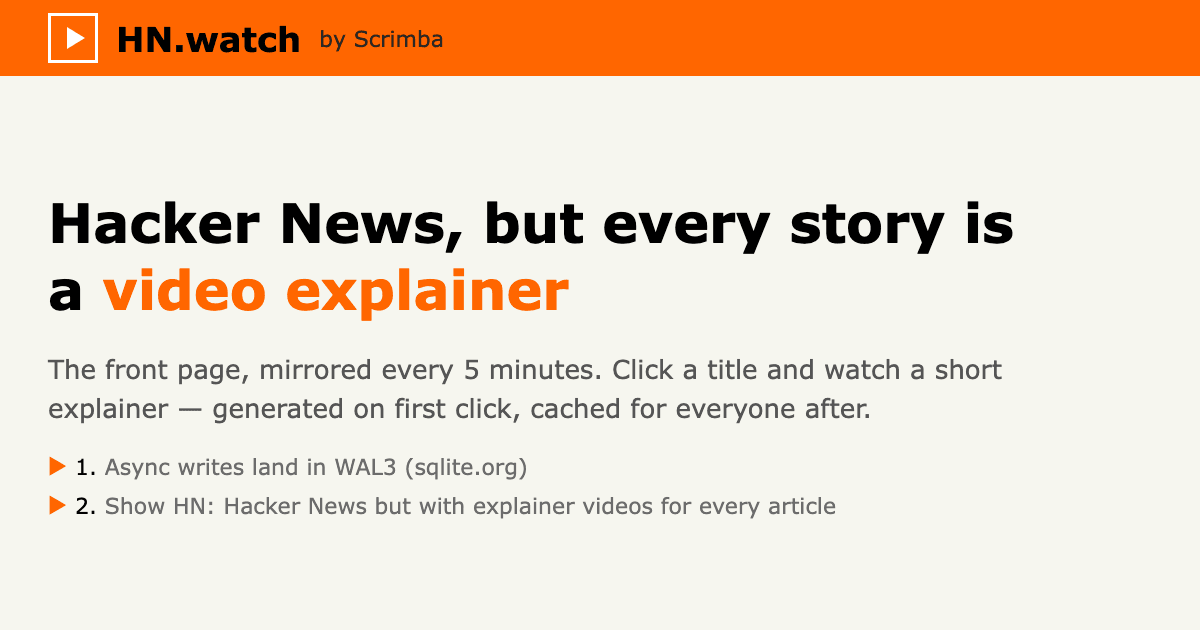
Scrimba launches HN.watch to turn Hacker News posts into videos
Per Borgen, founder of Scrimba (YC S20), announced HN.watch on September 28, 2026, a site that generates explainer videos for every Hacker News post. The videos...
Developer builds e-ink fridge magnet shopping list using Claude Code
A developer published a project on Hacker News on September 28, 2026, showing a shopping list built on an M5Stack PaperMono device, which uses an ESP32-S3...
TinyAIArena pits four AI models against each other on a grid
A developer posted TinyAIArena to Hacker News on September 27, 2026, presenting an open-source project that runs competitive matches between four AI models on an 8x8...