
TinyAIArena pits four AI models against each other on a grid
- Boom: TinyAIArena runs live competitive matches between four AI models on an 8x8 grid
- Boom: Project source code is publicly available at GitHub repository hp6/ai-arena
- Neutral: Users can spectate ongoing AI matches in real time through the interface
The story in full
A developer posted TinyAIArena to Hacker News on September 27, 2026, presenting an open-source project that runs competitive matches between four AI models on an 8x8 grid. The source code is available on GitHub at hp6/ai-arena, and users can spectate ongoing matches through the interface.
Analysis
313 wordsOn September 27, 2026, a developer posted TinyAIArena to Hacker News under the Show HN format, describing it as a live competitive environment where four AI models play against each other on an 8x8 grid. The project is open source, with the full code hosted at the GitHub repository hp6/ai-arena. Visitors to the interface can watch ongoing matches in real time by clicking into any active game.
The project sits at an intersection of AI benchmarking and game-playing research that has a long history, from early chess engines to DeepMind's AlphaGo and beyond. What distinguishes this kind of head-to-head arena format from traditional benchmarks is that performance is measured relationally, meaning a model's result depends directly on what its opponents do, rather than against a fixed test set. That makes the competitive dynamic more legible to general audiences, but it also raises questions about what the results actually reveal: whether grid-game performance reflects general reasoning capability, or something much narrower, is a genuine open question in the field.
None of the three camps have published reactions to this story yet. The Pro-AI camp would typically frame a project like this as a demonstration of how capable and competitive modern models have become, pointing to the spectacle of autonomous agents making strategic decisions in real time. The Anti-AI camp would likely question what is actually being measured and whether framing model outputs as gladiatorial combat obscures more than it illuminates about how these systems work and where they fail. The Middle Ground camp would probably welcome the open-source transparency while urging caution about reading too much into win rates on a constrained grid game.
The most informative next step would be the publication of which specific models are competing and their win-rate distributions over a large number of matches, since that data would give observers something concrete to evaluate rather than the format alone.
Where do you stand?
Add your take
0 reader votesSign in with Google to pick a side and post. Your vote moves the story's Doom / Boom score.
Sources
1 article from 1 outlet- Hacker News front page (AI)Show HN: TinyAIArena watch AI agents battle it out
Related Splits
All stories →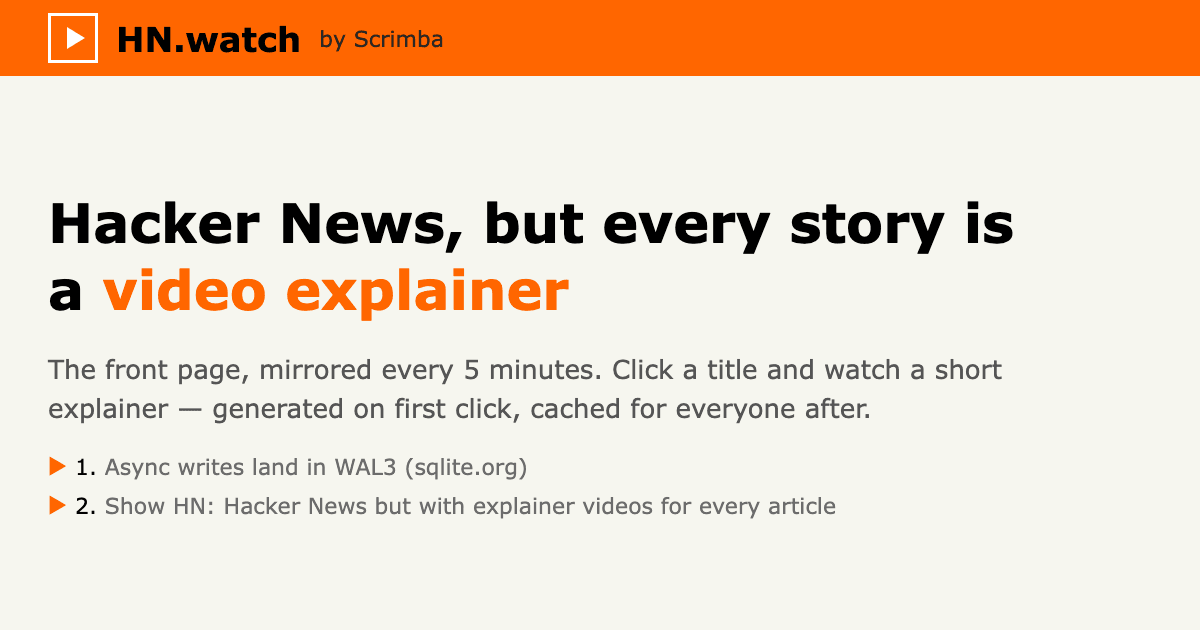
Scrimba launches HN.watch to turn Hacker News posts into videos
Per Borgen, founder of Scrimba (YC S20), announced HN.watch on September 28, 2026, a site that generates explainer videos for every Hacker News post. The videos...
Developer builds e-ink fridge magnet shopping list using Claude Code
A developer published a project on Hacker News on September 28, 2026, showing a shopping list built on an M5Stack PaperMono device, which uses an ESP32-S3...
Developer builds Claude Code tool to analyze chess games
A developer posted to Hacker News on September 26, 2026 a self-built tool that uses Claude Code alongside Stockfish to analyze chess games from Lichess. The...