
Nvidia announces RTX Spark PC chip with 1 petaflop AI compute
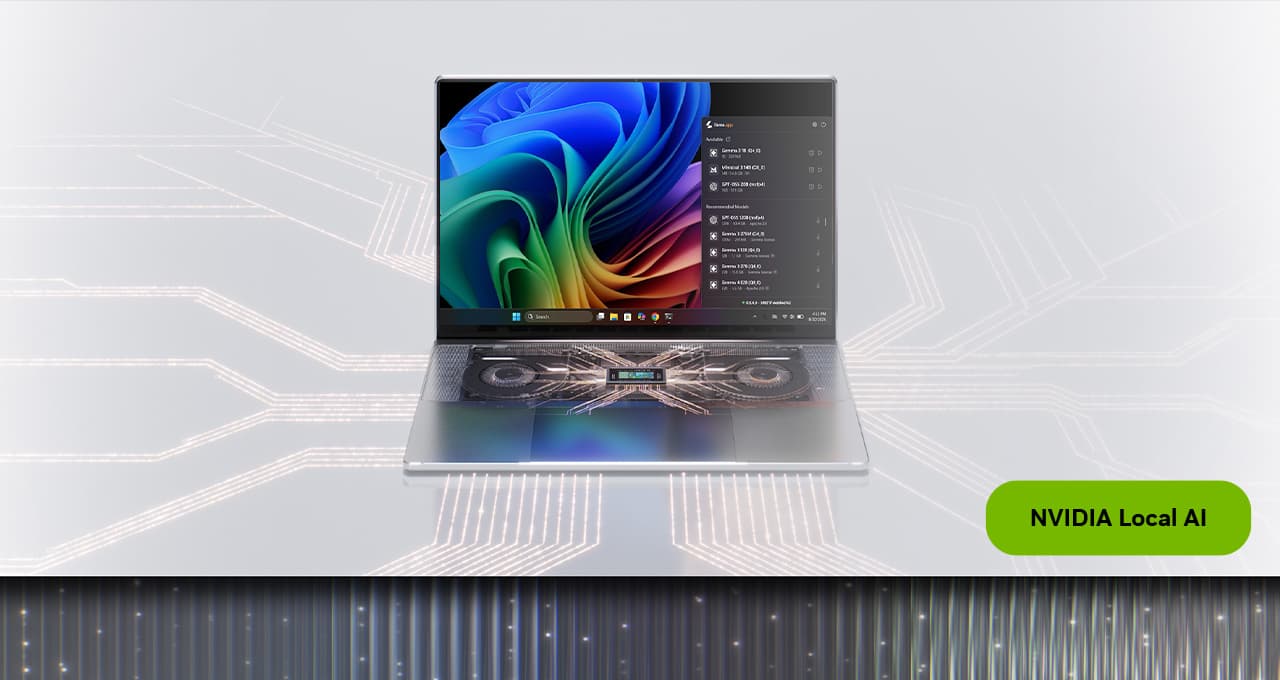 2 sources · NVIDIA Blog
- Boom: RTX Spark delivers 1 petaflop of AI compute in a single chip
- Boom: Chip supports up to 128 GB of unified memory
- Boom: Nvidia frames RTX Spark as combining gaming, creative studio and AI supercomputer
- Neutral: No launch date, pricing or hardware partners were announced
The story in full
Nvidia announced the RTX Spark on October 13, 2026, describing it as a superchip combining gaming, creative, and AI workloads in a single device. The chip offers up to 128 GB of unified memory and 1 petaflop of AI compute, and Nvidia says it runs the full RTX software stack.
Nvidia positions RTX Spark as a reinvention of the PC form factor rather than an incremental GPU update. No pricing, availability date, or third-party hardware partners are named in the announcement.
Analysis
369 wordsOn October 13, 2026, Nvidia announced a chip called RTX Spark, describing it as a superchip designed to consolidate gaming, creative, and AI workloads into a single piece of silicon. The headline specifications are 128 GB of unified memory and 1 petaflop of AI compute. Nvidia framed the announcement around software ecosystem readiness, positioning RTX Spark not as a discrete GPU upgrade but as a reimagining of what a personal computer can be. The company did not disclose pricing, a release date, or any third-party hardware manufacturers who would build devices around the chip.
The 1 petaflop figure is the number most likely to anchor the debate. A petaflop of AI compute on a consumer device would represent a meaningful threshold, enabling larger local language models and more capable on-device inference without cloud dependency. The 128 GB unified memory pool matters equally, because memory capacity is often the binding constraint when running modern AI workloads locally. What remains genuinely unresolved is whether the announced specifications will survive contact with shipping hardware, and at what price point the chip becomes accessible. Announcing ecosystem readiness before confirming device partners or a launch window leaves the practical timeline open.
Because no reactions from the Pro-AI, Anti-AI, or Middle Ground camps have been published yet, what each would typically argue can only be anticipated. The Pro-AI camp would likely treat the 1 petaflop milestone as validation that powerful AI is moving decisively to the edge, reducing reliance on data centers and putting capable models in individual hands. The Anti-AI camp would be expected to raise concerns about the normalization of always-available AI compute in personal devices, and might question whether consumer hardware at this scale accelerates harmful or low-oversight AI use. The Middle Ground camp would probably focus on the gap between the announcement and any concrete product, noting that specifications without pricing or partners say little about who actually benefits.
The clearest signal to watch for is the naming of hardware partners and a shipping date. Those details would allow independent benchmarks to test whether the 1 petaflop figure holds under real workloads, and pricing would determine whether RTX Spark represents a broad shift in consumer computing or a premium niche product.
Where do you stand?
Add your take
0 reader votesSign in with Google to pick a side and post. Your vote moves the story's Doom / Boom score.
Sources
2 articles from 1 outletRelated Splits
All stories →
NVIDIA highlights France's agentic AI deployments across multiple sectors
NVIDIA published a blog post on October 13, 2026, describing how French companies are deploying agentic computing across space, financial services, the public sector, and scientific...

Nvidia's China AI chip share drops to 34% as Huawei gains
According to IDC data reported on October 13, 2026, Nvidia's share of China's AI chip market has fallen to 34%, with Huawei closing the gap. Multiple...
Navitas and NVIDIA jointly develop 24 kW AI data center power board
Navitas Semiconductor collaborated with NVIDIA to produce an 800 V-to-12 V power delivery board rated at 24 kW, announced on October 12, 2026. The board is...