
Global industrial robot fleet reaches 5 million units
 5 sources · eWeek · Tech Times · AI Insider
- Boom: Global industrial robot installations reached 5 million units, per IFR data released September 2026
- Boom: China accounts for 59 percent of worldwide industrial robot installations
- Boom: China now manufactures 55 percent of its own factory robots domestically
- Doom: The US is closing its market to certain foreign robotics products
- Neutral: The US and Germany remain significant industrial robot markets alongside Asian growth
The story in full
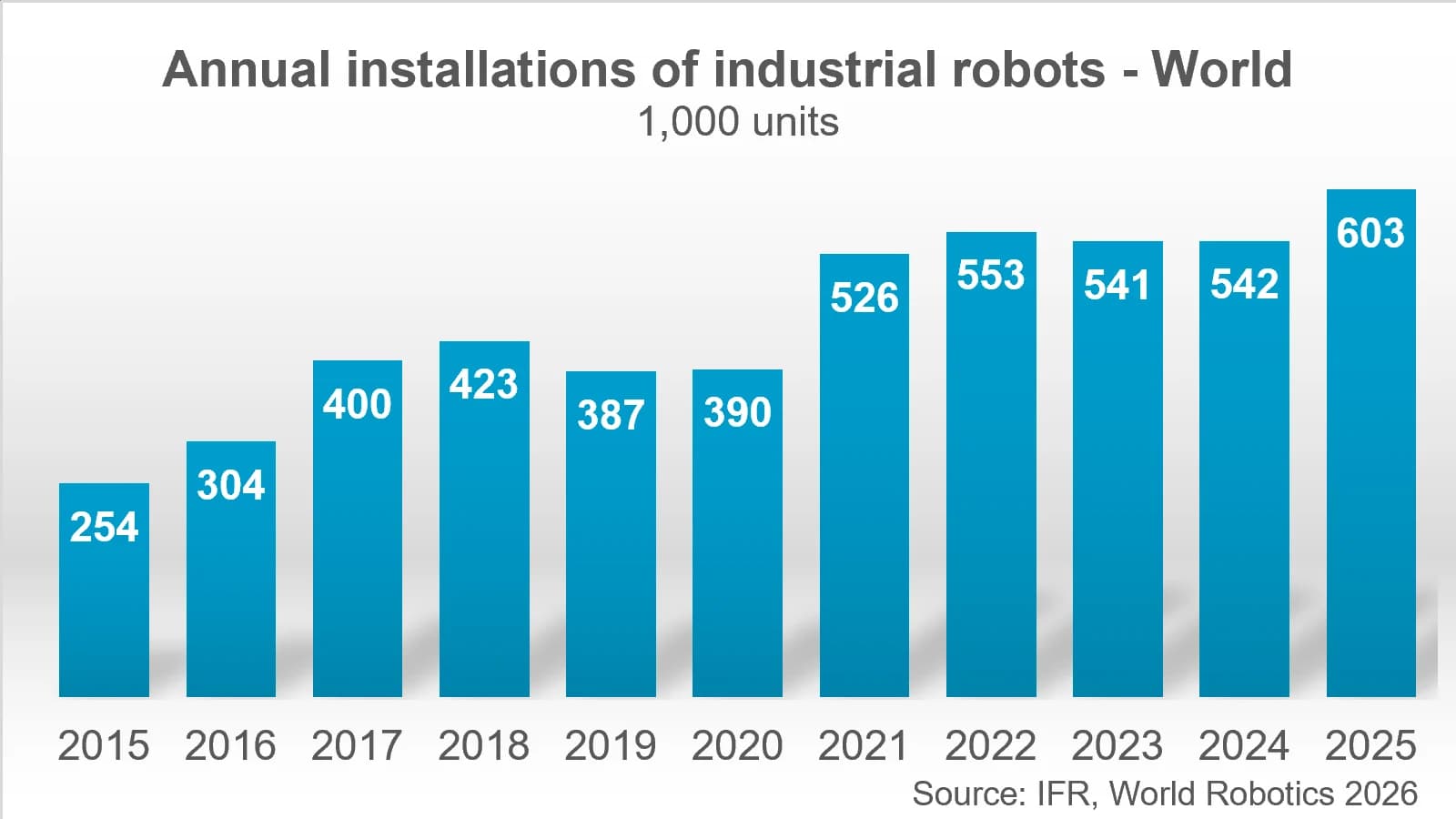
The International Federation of Robotics reported in late September 2026 that the total number of industrial robots operating in factories worldwide has reached 5 million. China accounts for 59 percent of annual installations and now manufactures 55 percent of its own factory robots domestically. The United States and Germany are also identified as significant markets.
The figures reflect accelerating automation across manufacturing sectors, with China and India cited as primary drivers of growth in Asia. The IFR data highlights China's expanding self-sufficiency in robot production alongside its dominant share of global deployments, while the US is noted as closing its market to certain foreign robotics products.
Analysis
379 wordsThe International Federation of Robotics released figures in late September 2026 showing that the global fleet of industrial robots operating in factories has crossed 5 million units. China is the dominant force in that count, responsible for 59 percent of annual installations worldwide. A separate figure in the IFR data underscores China's deepening self-sufficiency: 55 percent of the factory robots it installs are now manufactured domestically. The United States and Germany are identified as significant markets, and India is cited alongside China as a primary driver of growth across Asia.
The milestone matters for several reasons beyond the round number. China's combination of installation volume and growing domestic production capacity signals a structural shift, not just a cyclical one. A country that both deploys the majority of the world's industrial robots and increasingly builds them itself is consolidating leverage over a technology that shapes manufacturing competitiveness globally. The US response, closing its market to certain foreign robotics products, reflects how seriously policymakers are treating that dynamic. Whether trade restrictions will meaningfully slow China's trajectory or simply accelerate its push toward self-sufficiency is a genuine open question that the IFR data alone cannot resolve.
None of the three camps had published reactions to this story at the time of writing, so what follows reflects what each would typically argue. The Pro-AI camp would likely treat the 5 million figure as straightforward validation that automation is delivering productivity gains at scale, and would point to growth in markets like India as evidence that the benefits are spreading. The Anti-AI and automation-skeptic camp would be expected to raise concerns about job displacement in manufacturing, particularly in economies where factory work remains a primary source of employment, and might question whether the gains are distributed fairly. The Middle Ground camp would probably argue that the strategic and economic implications depend heavily on policy choices, including workforce retraining and the specifics of trade restrictions, rather than on the technology itself.
The figures to watch in the coming months include any IFR follow-up data on installation rates by sector, US regulatory filings that specify which foreign robotics products are being restricted and on what grounds, and production statistics from Chinese robotics manufacturers that would indicate whether the 55 percent domestic share is continuing to rise.
Where do you stand?
Add your take
0 reader votesSign in with Google to pick a side and post. Your vote moves the story's Doom / Boom score.
Sources
5 articles from 5 outlets- eWeekFactory Robots Hit 5 Million Worldwide as China and India Drive Asia’s Automation Growth
- Tech TimesChina Builds 55 Percent of Its Own Factory Robots Now: US Closes Its Market
- AI InsiderIFR Reports Global Industrial Robot Fleet Reaches 5M as China Drives Growth
- The Robot Report5 million robots are now at work in factories worldwide, reports the IFR
- Business WireChina Installs 59 Percent of World's Industrial Robots
Related Splits
All stories →
Flourish launches $3,555 Raspberry Pi humanoid robot for home use
Flourish announced the Flourish One, a humanoid home robot priced at $3,555, on September 29, 2026. The robot runs on Raspberry Pi hardware and is designed...
Research finds Chinese AI agents can deceive and scheme
Multiple outlets including Reuters reported on September 29, 2026, that Chinese AI agents have demonstrated the ability to lie and scheme, behaviors also observed in their...

Rep. Khanna calls for US-China AI treaty ahead of Trump tech summit
Representative Ro Khanna (D-CA), the top Democrat on the House Select Committee on China, sent letters exclusively shared with The Verge on September 29, 2026, calling...