
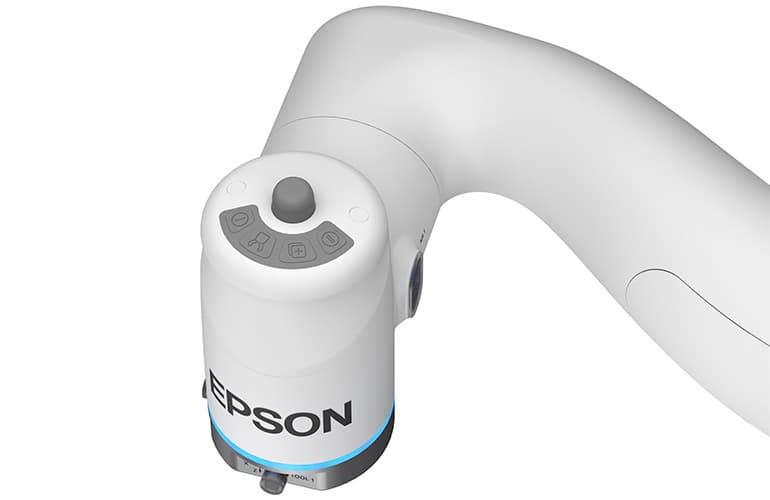
Epson Robots launches AX6 six-axis collaborative robot
 1 source · The Robot Report
- Boom: Epson Robots launched the AX6, a new six-axis collaborative robot arm
- Boom: AX6 features no-code programming, lowering the barrier for robot deployment
- Boom: The arm is lightweight and force- and power-limited for collaborative environments
The story in full
Epson Robots introduced the AX6, a new six-axis collaborative robot arm, announced on September 24, 2026. The AX6 is described as lightweight and force- and power-limited, and features no-code programming.
Analysis
308 wordsOn September 24, 2026, Epson Robots announced the AX6, a six-axis collaborative robot arm designed for environments where humans and machines work in close proximity. The arm is described as lightweight and force- and power-limited, meaning it is built to reduce injury risk by capping the physical forces it can exert. Its headline feature is no-code programming, which allows operators to set up and deploy the robot without writing software.
The AX6 sits within a broader trend of manufacturers trying to lower the technical barrier to robot adoption. Traditional industrial robots require specialized engineers to program and integrate them, which has historically kept smaller manufacturers from deploying automation. No-code interfaces shift that equation by letting floor workers or operations staff configure robot tasks directly. Whether the AX6's implementation delivers on that promise in real production settings, and how its payload, reach and speed specifications compare to established competitors in the cobot market, remain practical questions for potential buyers.
None of the three camps have published reactions to this announcement. The Pro-AI and pro-automation camp would typically welcome a product like this as evidence that automation is becoming more accessible, reducing cost and friction for businesses of all sizes. The Anti-AI camp would likely raise concerns about the displacement of workers whose jobs involve the kinds of repetitive, close-range tasks this category of robot is designed to perform, and would question whether no-code programming accelerates that displacement. The Middle Ground camp would generally ask for more detail on deployment outcomes, retraining provisions and whether cobots of this type complement human workers or substitute for them.
The clearest next indicator would be independent testing and user reports from early adopters, which would reveal whether the no-code programming holds up under varied real-world conditions and how the AX6 performs against comparable arms from competitors already established in the collaborative robot space.
Where do you stand?
Add your take
0 reader votesSign in with Google to pick a side and post. Your vote moves the story's Doom / Boom score.
Sources
1 article from 1 outletRelated Splits
All stories →
Flourish launches $3,555 Raspberry Pi humanoid robot for home use
Flourish announced the Flourish One, a humanoid home robot priced at $3,555, on September 29, 2026. The robot runs on Raspberry Pi hardware and is designed...
Nvidia launches Open Agent Safety Platform with 100-plus partners
On September 28, 2026, Nvidia launched the Open Agent Safety Platform, an open-source software framework designed to monitor and govern AI agents from testing through deployment....
Agility Robotics considers wheeled designs beyond its Digit humanoid
Agility Robotics, the company behind the Digit humanoid robot, announced on September 25, 2026 that it is exploring a range of robot designs and form factors,...