
DoubleAI launches Maxwell, a model that optimizes code at runtime
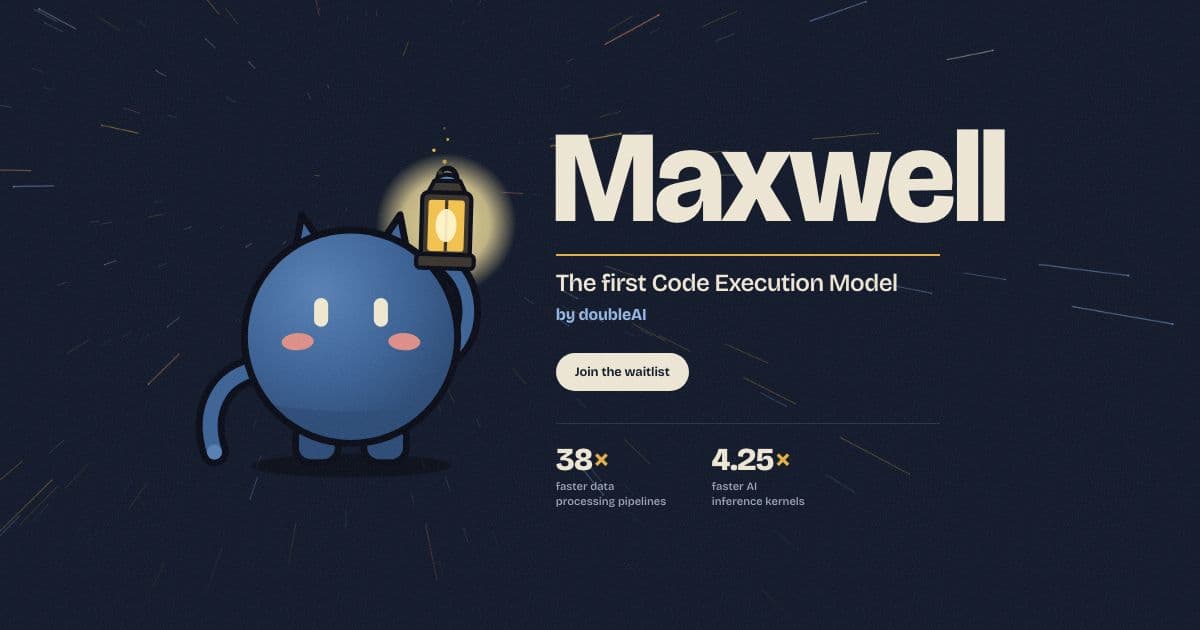 1 source · Hacker News front page (AI)
- Boom: Maxwell optimizes code execution speed in real time without changing source code
- Boom: The model ingests traces, profiling data, and live input signals during execution
- Boom: Maxwell adapts to hardware environment and other concurrently running processes
- Neutral: No human oversight is involved in Maxwell's runtime optimization loop
- Neutral: DoubleAI provided no benchmarks, pricing, or release availability in the announcement
The story in full
DoubleAI, founded by someone identified as Gal, announced Maxwell on October 19, 2025, describing it as a Code Execution Model. The model sits between application code and hardware, optimizing execution speed in real time without modifying source code, and operates without human oversight.
Maxwell works by observing programs from within, using traces, profiling data, and runtime input characteristics to adapt dynamically to the hardware environment and other running processes. The announcement was made via Hacker News; no performance benchmarks, pricing, or availability dates were included in the source.
Analysis
342 wordsOn October 19, 2025, Gal, a founder at DoubleAI, announced Maxwell on Hacker News, describing it as a Code Execution Model. The system positions itself as a layer between application code and hardware, optimizing execution speed in real time without altering source code. Maxwell does this by observing programs from within, drawing on traces, profiling data, and live input characteristics to adapt to the hardware environment and whatever other processes are running at the same time. The announcement included no performance benchmarks, pricing information, or release dates.
The core claim is technically ambitious. Runtime optimization is not new, compilers and just-in-time systems have approached this problem for decades, but Maxwell's framing as a frontier model that continuously adapts during execution, rather than ahead of it, positions the approach as meaningfully different. The absence of benchmark data makes independent assessment impossible at this stage, which is a significant gap given that performance claims are the entire basis of the product's value. The explicit statement that no humans are in the loop is notable because it describes an AI system making continuous, real-time decisions about how software executes, with no point of human review.
None of the three camps have published reactions to this announcement yet. The Pro-AI camp would typically welcome a system like Maxwell as an example of AI delivering concrete, measurable productivity gains for developers without requiring workflow changes. The Anti-AI camp would typically raise concerns about the absence of human oversight in a system that intervenes in live code execution, and would likely press hard on the lack of benchmarks as a reason for skepticism. The Middle Ground camp would typically acknowledge the technical interest while calling for rigorous, independent performance validation before treating the claims as established.
The most important thing to watch for is the release of concrete benchmark data, ideally from parties outside DoubleAI, showing what speed improvements Maxwell actually delivers across different hardware environments and workload types. Pricing and availability details would also clarify whether this is a research announcement or a product approaching general use.
Where do you stand?
Add your take
0 reader votesSign in with Google to pick a side and post. Your vote moves the story's Doom / Boom score.
Sources
1 article from 1 outlet- Hacker News front page (AI)Maxwell: A new kind of model that sits between code and hardware
Related Splits
All stories →Laminar launches flow-1 model to detect silent AI agent failures
Laminar, a YC S24 company founded by Robert and Din, released flow-1 on or around October 19, 2026. The model is trained with reinforcement learning to...

Researchers left Claude agents alone for 30 hours on virtual island
Researchers ran an experiment in which copies of Anthropic's Claude Opus 4.7, nicknamed Eko, were repeatedly placed alone on a virtual desert island for 30 hours...
Meta says Claude AI tool caused No Kings Instagram suspension
Meta attributed the suspension of the No Kings Coalition's Instagram account to activity from Anthropic's Claude AI tool, stating the action was a mistake. The suspension...