
Developer releases quiz game built around TypeSafe Jev vision model
 1 source · Hacker News front page (AI)
- Boom: TypeSafe's Jev vision model answers picture quiz questions in about 0.25 seconds
- Boom: Jev Cards launched October 20, 2026, with solo leaderboards and live multiplayer modes
- Neutral: Developer built all quiz cards from scratch; more card sets planned over time
The story in full
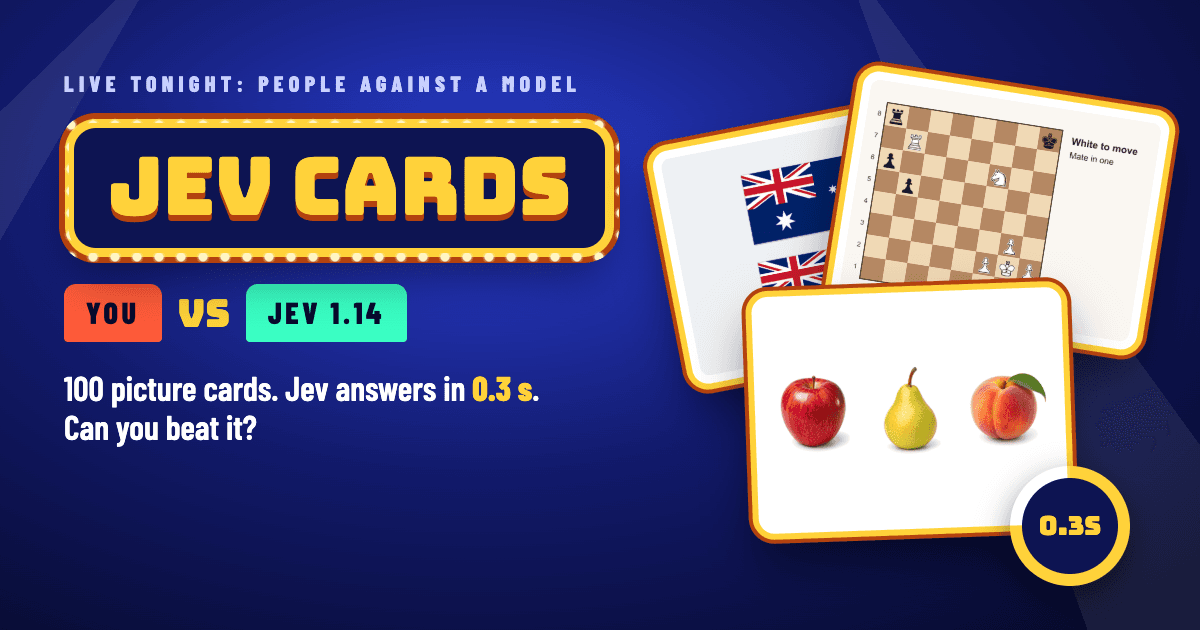
A developer posted a browser-based quiz game called Jev Cards to Hacker News on October 20, 2026, built around TypeSafe's Jev model. The game presents picture-based questions and the Jev model selects answers or taps image locations in approximately 0.25 seconds.
The game supports solo play with per-mode leaderboards and live multiplayer matches. The developer created all quiz cards from scratch and states the model receives the same image shown to the player. Additional card sets are planned for future release.
Analysis
391 wordsOn October 20, 2026, a developer posted Jev Cards to Hacker News under the title "Show HN: Jev Cards, Can you beat a vision model at a picture quiz?" The game is browser-based and built around TypeSafe's Jev vision model. When a player encounters a picture question, Jev processes the same image the player sees and either selects a multiple-choice answer or taps a location on the image in roughly 0.25 seconds. The developer built every quiz card from scratch and designed the game to support both solo play with per-mode leaderboards and live multiplayer matches against other users. More card sets are described as coming in the future.
The project sits at an intersection of two ongoing conversations: how capable vision-language models have become at general visual reasoning, and what it means to compete against AI in a consumer-facing game. A quarter-second response time for image-based questions is fast enough that human reaction alone cannot close the gap, which raises questions about what "competing" with the model actually means in practice. The game also functions as an informal benchmark, placing Jev's vision capabilities in front of a broad public audience rather than a controlled evaluation setting, which gives it a different kind of signal than laboratory results.
None of the three camps have published reactions to Jev Cards yet. The Pro-AI camp would typically treat a project like this as a demonstration of how capable and accessible vision models have become, pointing to speed and accuracy as evidence of meaningful progress. The Anti-AI camp would typically raise concerns about the asymmetry of the competition, questioning whether framing a 0.25-second model response as a game obscures how thoroughly AI outpaces humans on tasks once considered casual and human. The Middle Ground camp would likely focus on the design choices, asking whether the game is most useful as entertainment, as a public stress test of the model, or as a starting point for thinking about human-AI collaboration in interactive contexts.
The clearest thing to watch going forward is how Jev Cards performs in actual multiplayer sessions, since live competition against other players alongside the model will reveal whether the speed gap creates an engaging dynamic or simply makes human participation feel futile. The release of additional card sets will also test whether Jev's performance holds across a wider range of visual categories.
Where do you stand?
Add your take
0 reader votesSign in with Google to pick a side and post. Your vote moves the story's Doom / Boom score.
Sources
1 article from 1 outlet- Hacker News front page (AI)Show HN: Jev Cards, Can you beat a vision model at a picture quiz?
Related Splits
All stories →Developer builds free WhatsApp MCP connector for Claude on Cloudflare
A developer posted on Hacker News on October 18, 2026 a self-built tool that connects Claude to WhatsApp messages via the Model Context Protocol, running at...
Developer uses Claude Opus 5.5 to generate 500 web clocks
A developer shared a 6.3 MB self-contained HTML file containing 500 clock designs, each generated by Claude Opus 5.5 across multiple sessions in the Claude chat...
Developer releases open-source tool that quizzes coders on AI-generated code
A developer posted a free and open-source tool called Sphinx to Hacker News on October 18, 2026. The tool hooks into existing coding agent workflows and...